
Why Earn Your Doctor of Criminal Justice Degree in Human Services at Saint Leo University?
The Doctor of Criminal Justice at Saint Leo University prepares students to make important contributions within an increasingly dynamic and complex domain. The program enables students to critically assess theoretical concepts, intervention modalities, public policy, social order issues, as well as a broad range of criminal justice practices that impact law enforcement, corrections, and the courts. The curriculum prepares learners for careers in teaching, homeland security, human services, and criminal justice while allowing them to achieve proficiency in research, leadership, and the ethical application of processes so they can have the greatest influence on this profession.
This program is offered:
Online
The Human Services specialization receive (18) credits hours, providing the student with a terminal degree in Criminal Justice & Human Services.
Est. Time to Complete:
3-4 years
Credit Hours:
60 hours
Doctor of Criminal Justice Degree in Human Services Program Details
The online Doctorate in Criminal Justice with a specialization in Human Services at Saint Leo University is designed for individuals aiming to advance their careers in the criminal justice field by developing expertise in human services. The program focuses on the integration of criminal justice and human services principles to enhance leadership and administrative roles in various criminal justice settings.
Classes in Program
This course will introduce the human services discipline by providing the historical context and the evolution of the human services profession. Theoretical models and the discipline’s professional ethical standards and codes of conduct that today’s professional apply in everyday practice will be examined. The origins of the profession and ways in which philosophical and ideological perspectives have defined the fields of practice in numerous settings and serving various populations will be studied.
This course will employ a hands-on approach ultimately culminating in a hypothetical program evaluation and service-level improvement by completing weekly process goals, to include analysis of a completed needs assessment survey. In the process of learning evaluation techniques and skills, students will become proficient at critically analyzing evaluation studies conducted by others. The course will provide students with all materials needed in order to evaluate the complex program presented and complete tasks to ultimately modify it by the end of the term.
This course examines public policy analysis and covers key theoretical dimensions of policy analysis. The topics will include a range of policy tools that decision makers draw from to achieve policy objectives and various forms of policy evaluation methods in the execution of public policy. This course provides opportunities to interpret complex and conflicting data, evaluate alternative courses of action and discover the consequences of policy choices. Students will develop a policy research and modeling skillset in considering complex, real-world issues involving multiple actors with diverse interests, information uncertainty, institutional complexity, and ethical controversy.
This course will provide a systematic review of the wide range of cultures and individual differences and the ways in which cultural mores, ethnocentrism, and factors such as matters of race, gender, religion, sexual orientation, customs and cultures impact behavior of the individual themselves and of those around them. Concepts, models, frameworks, and communication that occur in cross-cultural situations will be discussed and applied. This course will examine both analytical and practical approaches to cultural competency.
This course examines the theories and research underlying the political, economic, and social structures related to community organizations within contemporary society. Students analyze methods of creating engaging communities and social justice organizations that empower and support individuals to work together to initiate social justice change. The course presents a framework for how community engagement organizations can advance their social justice mission through strategic partnerships that utilize their core competencies.
This course introduces to the process of grantsmanship using a step-by-step approach.
Strategic use of research skills to match need to proposed program and program to funding foundation will be discussed. This course will cover the key components in grant proposal writing
Learn Your Way:
Online
-
![online university student working on laptop]()
-
What are the benefits of earning your criminal justice degree online?
Saint Leo University’s online learning experience provides a well-rounded education with the flexibility to tailor your course of study to meet your individual needs. We know our students have lives outside school, and we seek to meet them where they are. Online students can count on receiving excellent academics as well as opportunities for hands-on learning.

Specialization Options
Saint Leo University offers specialization options for criminal justice students. You can customize your degree to match your passions by choosing one of the following concentrations.
The online PhD Criminal Justice Education track's curriculum prepares learners for careers in teaching and criminal justice while allowing them to achieve proficiency in research, leadership, and ethical application of processes so they can have the greatest influence on this profession.
- EDU 706 - Instructional Technology
- EDU 709 - Technology Innovation and Diffusion
- EDU 723 - Power of Teacher Leader Innovation
The online doctorate in Criminal Justice Homeland Security track's curriculum prepares learners for careers in homeland security and criminal justice while allowing them to achieve proficiency in research, leadership, and ethical application of processes.
- DCJ 707 - Systems Approach to Homeland Security
- DCJ 712 - Terrorism, Domestic Radicalization
- DCJ 722 - Organizational and Community Resilience
Career Outlook
No matter which learning experience you choose, you will receive plenty of professional development opportunities, industry knowledge from expert professors, and support from the Saint Leo community. All this together means that you will be ready for a successful career or continued studies upon graduation.
-
![Saint Leo University students in Psychology classroom]()
-
How will you gain real experience?
Classroom learning is only part of the criminal justice degree program at Saint Leo University. We also know the value of hands-on experience. That is why internships and research projects are built into the curriculum. Saint Leo has a strong relationship with many internship organizations across the country, including Boys & Girls Club and Head Start.
Plus, our Career Services center is always available to help connect you with a variety of other experiential learning opportunities to fit your individual career goals.

What are the top criminal justice degree jobs?
| Career | Growth | Salary |
|---|---|---|
| Postsecondary Teacher | 12% (Faster than average) | $80,560 per year |
| Lawyer | 9% (As fast as average) | $126,930 per year |
| Executive | 8% (As fast as average) | $107,680 per year |
From the Bureau of Labor Statistics, 2020.
Student Stories
The English minor strengthened my writing acumen while also supporting my Theatre major. In my senior year at Saint Leo, I wrote and directed an original play for my senior project, an experience directly shaped by my course work in the minor: Introduction to Dramatic Writing, Graphic Novels to Film, and Shakespeare. These courses strengthened my ability to read closely, write analytically, and develop character-driven interpretation and analysis, while also preparing me for graduate study abroad by building independence and discipline in my academic work.
My English minor played an important role in my acceptance to Politecnico di Milano (PoliMi), the #1 university in Italy, and my admission to Accademia Teatro alla Scala. The writing I completed for my minor prepared me very well for both application processes and scholarship materials.
Paul Vitaliti, Class of 2025, English Minor, Theatre Major.
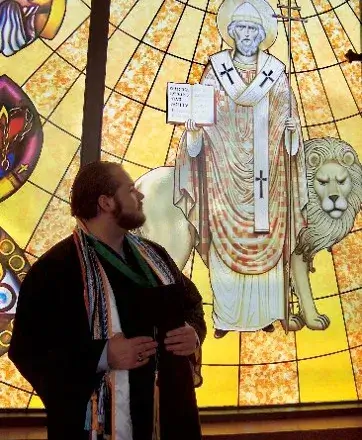
In the English major, we are tight knit. It has been much easier to befriend my classmates within my major than those in my general education classes. I am grateful for the time we have spent together in and outside of the classroom. The classes are not only engaging but thought-provoking. The major isn't simply about learning certain subjects, but to build our critical thinking and argumentative skills. We are taught to analyze every topic and form our own ideas for a nuanced debate or report. The English major has offered me the chance to build both my creative and academic writing skills through the classes offered at Saint Leo.
Emma Garrett: Class of 2027

The versatile English degree provides the foundation for many career paths, just as stories and narratives have provided the foundations of civilizations since humans started communicating. At Saint Leo, you explore the historical context behind why those stories exist in the first place. You’ll explore narratives from across cultures through many lenses and learn how to effectively participate in dialogue through research and analysis. The benefits are wide-reaching. I graduated with an English degree and then pursued an M.B.A. at Saint Leo. This combination has helped me navigate many roles in which effective communication, analysis, creative solutions and strategies dominate: Quality Assurance, Project Management, Paid Ads, and Search Engine Optimization. My English degree has also been instrumental in teaching me the necessary skills to publish my creative work in Dancing Girl Press and Frogpond and publish an article about data storytelling with Search Engine Land. I highly recommend the English degree at Saint Leo!
Amanda Beil: Class of 2013, Published Author, Project Manager

As an English major, I learned the power of writing and communication to motivate, change, obscure, and apologize. The program cultivated my deep curiosity about the stories we live with and who gets to tell them. I graduated from the English major with an uncanny comfort engaging in ideas, artifacts, and practices that were outside of my comfort zone. Classes created meaningful, challenging, fun, and productive discussions, moments where I was forced to commit my ideas to paper and review them with peers—the unsung moments of professional development that the English Major provides. Literature is a playground for conflict, strife, and love: The complexities of life.
Wesley Johnson, Class of 2010—Assistant Professor

The English major continues to shape my life today. The program fostered intellectual curiosity, critical thinking, and a deep appreciation for the power of clear communication. Through meaningful discussions, constructive feedback, and self-reflection, I learned how to listen, adapt, and grow. Moreover, those lessons became the foundation of a rewarding career in medical writing. For nearly two decades, I have helped communicate complex scientific research through clinical study reports, protocols, and regulatory submissions that contribute to bringing new treatments to patients.
Mary Goodwin (Stevens), Class of 2007—Medical Writer

My Saint Leo English degree laid the foundation for my career as an attorney (J.D.) and Army Public Affairs Officer. I sharpened my ability to write persuasively, learned to view an issue from multiple angles and write about it objectively, and developed my research skills. All of these are critical to my law practice today. Additionally, as a Public Affairs Officer, I supervised Army writers, editors, photographers, and videographers in the United States and abroad. This work has taken me to various locations in the U.S., Europe, South America, and Africa. Though I’ve moved over to a position in Intelligence now, the communication skills started at Saint Leo continue to benefit me today. Your English degree can take you far.
Grant Schrantz, Class of 2015 - Attorney

Accreditation
Saint Leo University is accredited by the Southern Association of Colleges and Schools Commission on Colleges to award associate, bachelor’s, master’s, specialist, and doctoral degrees.